Tag Audit — How to Read the Outcome Tags Voxinity Applies
answered, not answered, ai voice appointment booked, ai chat booked — these are the tags Voxinity writes back to your CRM after every interaction. Here's how to read them.
After every call and every chat session, Voxinity writes a small set of outcome tags back to the contact in your CRM — and surfaces them in the Tag Audit card on the Contact Timeline. These tags are the truth source for your reporting, your dashboards, and your refund/dispute defense. If you only learn one thing about Voxinity, learn how to read these four tags.
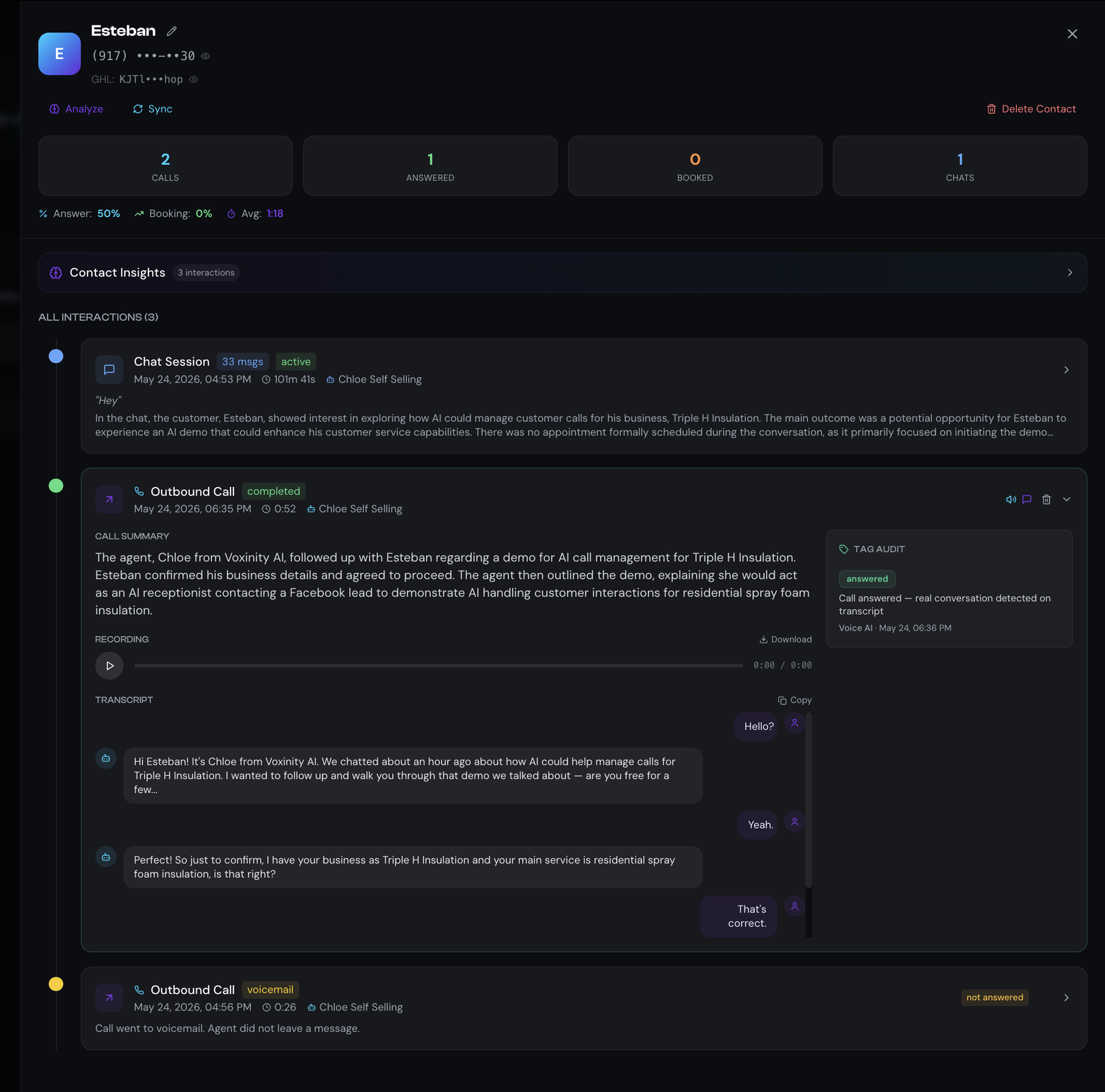
The 5 outcome tags Voxinity applies
Every AI tag action appears in TAG AUDIT (new — Feb 2026)
Beyond the 5 outcome tags, TAG AUDIT now logs EVERY tag the AI added or removed during the conversation in chronological order — including custom tags fired by the agent's `add_tag` / `remove_tag` function tools. You see the full story of what the AI did, not just the outcomes.
Reading the TAG AUDIT card
Every call card in the Contact Timeline has a TAG AUDIT panel on its right side. It shows:
- The tag badge itself (answered / not answered / booked).
- A plain-English reason — e.g. 'Call answered — real conversation detected on transcript' or 'Call went to voicemail. Agent did not leave a message.'
- The source — Voice AI or Chat AI — so you know which side of Voxinity applied it.
- The timestamp — when the tag was written to LeadConnector.
If you don't see a TAG AUDIT card on a call, the AI didn't apply ANY outcome tag — usually because the call is still in progress or it ended in a failure state before the post-call analyzer ran.
Where these tags show up
Common questions
The activation tag is different (and that's intentional)
Don't confuse outcome tags with the activation tag.